Inman steamship City of Berlin, North Atlantic
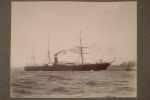 |
 City of Berlin

 (later Berlin, Meade) Liner (1f/3m). L/B: 488.6 bp × 44.2 (148.9m ×
 13.5m). Tons: 5,491 grt. Hull: iron. Comp.: 1st 170, 2nd 100, 3rd
 1,500. Mach.: compound engine, 1 screw; 15 kts. Built: Caird & Co.,
 Greenock, Scotland; 1875.

 The Inman Steamship Company's City of Berlin was a remarkable ship in
 many respects. Most noticeably, she had the highest length-to-beam
 ratio (11 to 1) of any major North
 Atlantic steamship. (By comparison, her contemporary Scotia was about
 8:1, and France/Norway is about 9:1.) On her fifth voyage between
 Liverpool and New York, she twice captured the Blue Riband, crossing
 from Queenstown to Sandy Hook at 15.21 knots (7 days, 18 hours, 2
 minutes; September 17-25, 1875) and returning at 15.37 knots (7 days,
 15 hours, 28 minutes; October 2-10). In December 1879, she became the
 first transatlantic steamship fitted with electric lights for interior
 spaces. To begin, there were four in the main saloon and two in the
 steerage compartments. As the Liverpool Journal of Commerce reported,
 the latter "continuously shed a brilliancy hitherto unknown in the
 steerage part of any vessel." During a major refit by Laird Brothers
 in 1887, City of Berlin was given triple expansion engines and
 electric lighting was extended throughout the ship. Inman was
 dissolved in 1893, and City of Berlin was sold to the American Line
 and renamed Berlin, though she remained on the same route. Two years
 later, she passed to the Red Star Line and made seven voyages between
 Antwerp and New York. In 1898, she sailed a few times between
 Southampton, Queenstown, and New York, but later in the year she was
 purchased by the U.S. government and commissioned as the U.S. Army
 Transport Service ship Meade. She saw service in both the
 Spanish-American War and World War I. Damaged by fire at San Francisco
 in 1906, she was scrapped in 1921.

 Bonsor, North Atlantic Seaway.
 City of Berlin

 (later Berlin, Meade) Liner (1f/3m). L/B: 488.6 bp × 44.2 (148.9m ×
 13.5m). Tons: 5,491 grt. Hull: iron. Comp.: 1st 170, 2nd 100, 3rd
 1,500. Mach.: compound engine, 1 screw; 15 kts. Built: Caird & Co.,
 Greenock, Scotland; 1875.

 The Inman Steamship Company's City of Berlin was a remarkable ship in
 many respects. Most noticeably, she had the highest length-to-beam
 ratio (11 to 1) of any major North
 Atlantic steamship. (By comparison, her contemporary Scotia was about
 8:1, and France/Norway is about 9:1.) On her fifth voyage between
 Liverpool and New York, she twice captured the Blue Riband, crossing
 from Queenstown to Sandy Hook at 15.21 knots (7 days, 18 hours, 2
 minutes; September 17-25, 1875) and returning at 15.37 knots (7 days,
 15 hours, 28 minutes; October 2-10). In December 1879, she became the
 first transatlantic steamship fitted with electric lights for interior
 spaces. To begin, there were four in the main saloon and two in the
 steerage compartments. As the Liverpool Journal of Commerce reported,
 the latter "continuously shed a brilliancy hitherto unknown in the
 steerage part of any vessel." During a major refit by Laird Brothers
 in 1887, City of Berlin was given triple expansion engines and
 electric lighting was extended throughout the ship. Inman was
 dissolved in 1893, and City of Berlin was sold to the American Line
 and renamed Berlin, though she remained on the same route. Two years
 later, she passed to the Red Star Line and made seven voyages between
 Antwerp and New York. In 1898, she sailed a few times between
 Southampton, Queenstown, and New York, but later in the year she was
 purchased by the U.S. government and commissioned as the U.S. Army
 Transport Service ship Meade. She saw service in both the
 Spanish-American War and World War I. Damaged by fire at San Francisco
 in 1906, she was scrapped in 1921.

 Bonsor, North Atlantic Seaway.
Here are 3 associated individuals:
|
|
